
Subscriber Benefit
As a subscriber you can listen to articles at work, in the car, or while you work out. Subscribe Now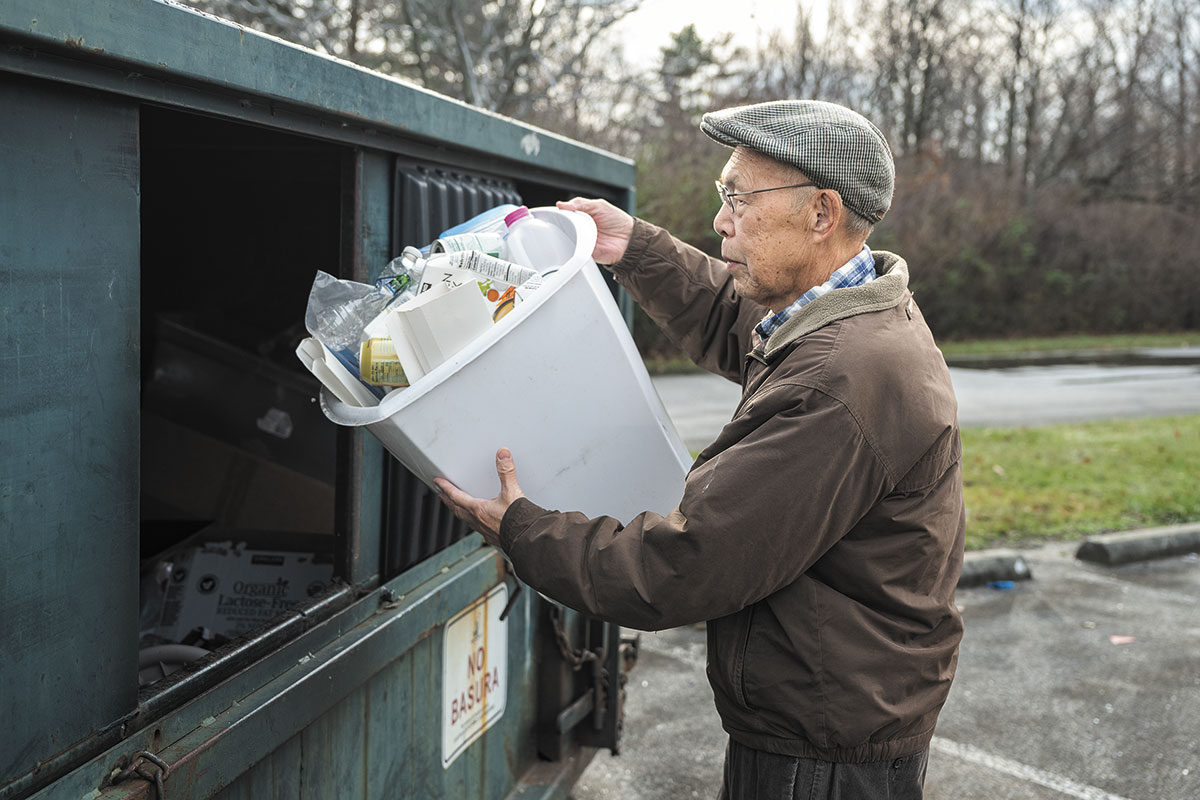
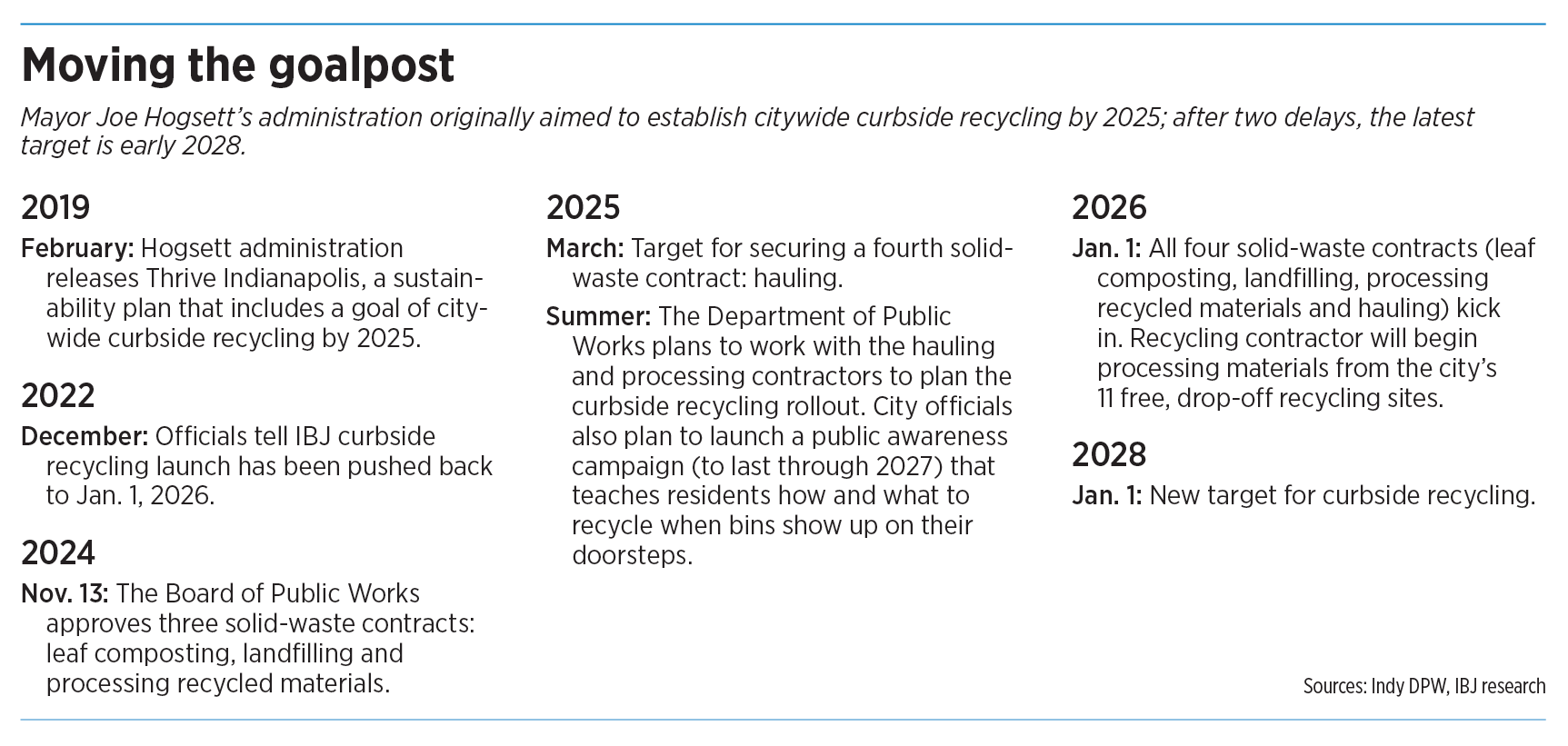
Indianapolis’ 2019 sustainability plan laid out a clear goal: “Provide universal residential curbside recycling to all Indianapolis residents by 2025.”
But in November, a Department of Public Works staffer revealed to the Board of Public Works in a public meeting that the administration is now planning for a rollout in 2028—three years later.
That means Mayor Joe Hogsett—whose administration set the goal in 2019 and who highlighted sustainability in his first campaign for reelection—probably won’t be in office when the curbside pickups begin (assuming he keeps his pledge not to run for a fourth term).
The Mayor’s Office declined to comment on the delay. Spokeswoman Aliya Wishner told IBJ in an email that it would not be appropriate for the mayor to comment for the story because DPW is in “active negotiations related to the procurement process” of companies that will eventually handle recycling.
IBJ’s request, however, did not directly address the procurement process. IBJ also sent a list of questions to Wishner, but the Mayor’s Office did not address them.

Multiple news outlets reported as recently as April that the process to establish curbside recycling was on track for completion in 2026, one year later than the original goal. Advocates and elected city-county councilors also thought that date was on track. They told IBJ the administration has not shared details about a change in the timeline.
Indianapolis holds the distinction of being the largest city in the United States without universal curbside recycling. With 2028 as the new goalpost, recycling advocate Ken Miller said the administration is “kicking the can down the road.”
Miller, a board member for sustainability nonprofit Circular Indiana, and the group’s former executive director, Allyson Mitchell, told IBJ the Hogsett administration has shown a lack of leadership on the issue of curbside recycling.

Mitchell, who led Circular Indiana from 2018 to 2022, described the most recent change in timing as “disappointing but not surprising.”
Councilor Dan Boots, an attorney who was elected to the council in 2020 and sits on the City-County Council Public Works Committee, was similarly disappointed. He told IBJ in December that he had heard “rumors” that the city was postponing implementation again, this time to 2028. He wasn’t told directly that the timeline had shifted but said he suspected it when the Hogsett administration did not give the council updates.
“We’ve been talking about recycling for a couple years, and we’re not getting any positive reaction or positive engagement from the administration,” Boots told IBJ. “I took it that this recipe is not going to be cooked in time and that it’s not going to be fulfilled per our expectations.”


Mo McReynolds, the city’s Office of Sustainability interim director, said the 2026 timeline became unfeasible.
“We could have never predicted a pandemic, nor could we have predicted the financial strain that would [be] put on our [residents] or the city itself to try to recover from. So much of this is based on the fiscal solvency of this program and what we’ll need to support it in not wanting to pass off all of those expenses to our taxpayers.”
In a statement provided to IBJ—initially without attribution but later attributed to DPW Deputy Director of Policy and Planning Natalie Van Dongen—officials wrote that “[a]fter years of working toward implementing the solid waste minimization plan, the City remains focused on delivering new trash and curbside recycling services for our residents in the most responsible and effective way.”
“DPW looks forward to entering into new contracts for these services over the coming months and beginning the process to educate Indianapolis households on and roll out these new services over the following years,” the statement continued.
Timing of shift
Public documents narrow the window in which city officials shifted their timeline. Early this year, a bid document seeking companies to process recyclable materials did not include a target start date for universal curbside recycling. Instead, the document says the contractor will be responsible for processing more recyclable materials “if the city implements universal curbside recycling” during the decade-long term.
A later request for proposals, released in October, asks that solid waste collectors meet a 2028 universal curbside recycling goal.
The first public indication that the timeline for curbside recycling had changed came during the public meeting on Nov. 13 when Daniel Stevenson, administrator of strategy and technology for DPW, presented waste contracts to the Board of Public Works.
Dan Haake, a member of the board, questioned the change. “What’s the rationale behind waiting until 2028 to do curbside recycling? It seems four years is quite a time,” he said.
Stevenson cited a need to work with new contractors, whose terms begin in 2026. He also highlighted a need for more time to educate Marion County residents on recycling.


“What is this new cart that’s going to show up at their house, going to be for what kind of materials can be disposed via recycling, etc.?” Stevenson said, referring to what homeowners might be thinking when recycling begins. He said the city will begin educating residents in 2026.
City-County Council Environmental Sustainability Committee Chair John Barth learned about the delay for the first time at the November Board of Public Works meeting. Despite efforts the councilor has made to be involved in the process—including hosting three meetings about recycling in 2023—he said he didn’t know why the administration had pushed the process back two more years.
“Having a rollout that ended in 2028, that news is new to me,” Barth told IBJ. “But the concept of rolling it out over time isn’t new to me.”
Contract obligations
The 2025 target was originally chosen because it coincided with the expiration of the city’s four solid-waste contracts, which meant curbside recycling could be negotiated into the new agreements. The new contracts will still take effect at the start of 2026, but the vendors won’t begin hauling and processing recyclable materials off of doorsteps until 2028.
According to the request for proposals for solid-waste hauling, the contractor will provide and maintain one 96-gallon cart per household when universal curbside recycling commences in 2028. The contractor will pick up the recyclables at least every other week on the same day as trash collection. The vendor will then transport recycled materials to a designated processing facility.
The city will pay the cost to process recycling materials and will receive any revenue from recycled materials, paid by the processing facility as rebates. If the contractor is unable to market the recyclables, it is to notify the Department of Public Works director.
The company selected to process recyclable materials—Waste Management of Indiana, a subsidiary of Houston-based Waste Management Inc.—is charged in the request for proposals with the responsibility of assisting with public education and advertising. The Hogsett administration asks in the document that Waste Management offer up to three classroom educational seminars on recycling per month in Marion County schools.
Additionally, Waste Management is required to purchase at least a quarter-page advertisement in The Indianapolis Star at least two times per year. Those advertisements will promote the drop-off recycling program or the universal curbside program.
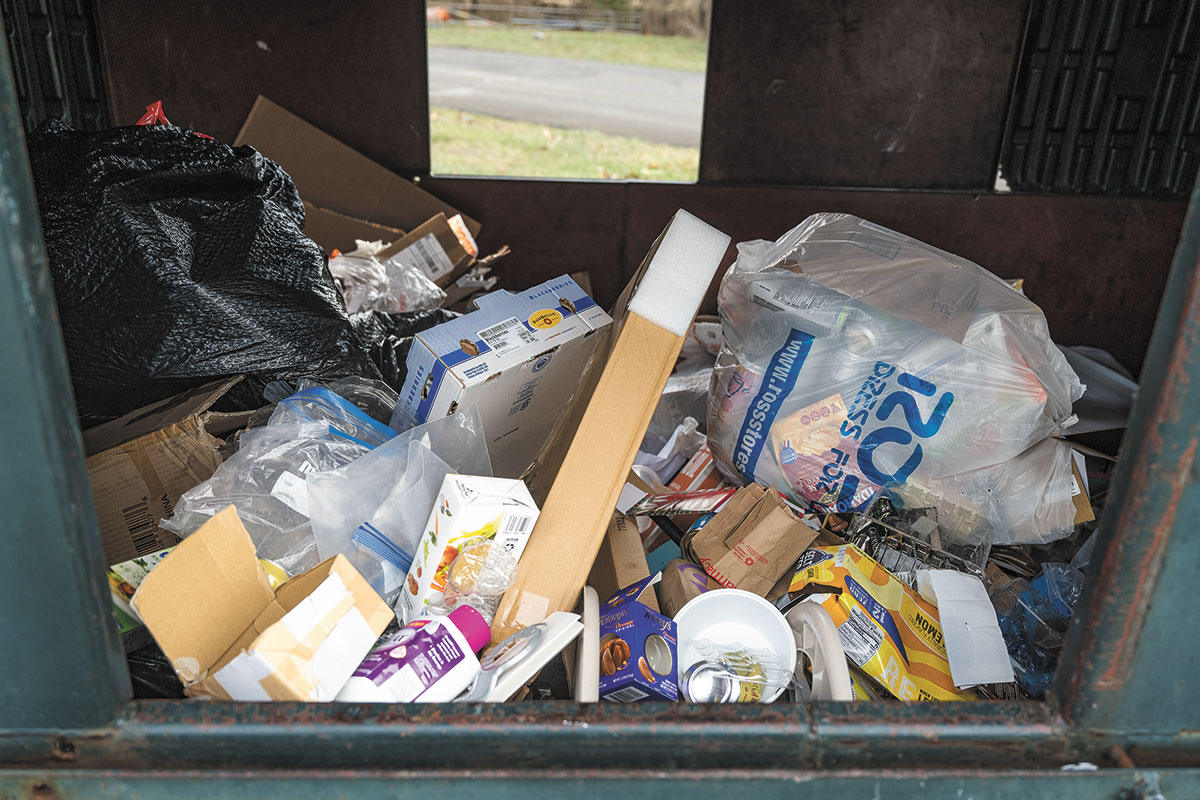
Finally, the contractor is required to provide and maintain at least 15 recycling drop-off containers to be distributed across Marion County.•
Please enable JavaScript to view this content.
Complete and utter failure by the mayor’s office and everyone else involved.
It’s a shame that a city as large as Indianapolis doesn’t have mandatory curbside recycling. As bad as Memphis Tennessee is with some things they do manage to get this right.
Ah yes, another “disappointing but not surprising” story about the Hogsett administration
Whay choose Waste Management when Republic Services does a fine job of picking up recycleable materials for those of us in Indianapolis who pay for that service now?
Both WM and Republic have really good recycling programs. Certainly a possibility that the city could privatize this effort as opposed to adding to the already bloated city/county government.
I wouldn’t call it really good. It’s fair. More than half the plastic I get can’t be recycled. They will reject any plastic bags, from standard plastic garbage bags to the plastic padded Amazon envelopes.
The original Thrive Indianapolis plan was actually originally put in place in 2018 with a 2019 start. Mayor Ballard was mayor when this was agreed to and Mayor Hogsett has never actually had interest in following through. There was also supposed to be trial curbside recycling for part of Indianapolis in 2023; this has not happened yet and thus the need to delay until 2028. Also, notice that subscription curbside compost pickup is also supposed to be in place for all Indianapolis in 2025; there is absolutely no update from the city on moving forward with this initiative. See the link to the 2018 copyright website below for more information.
https://www.thriveindianapolis.com/waste-recycling
I should correct my posting. Mayor Hogsett was in office in 2018, not Mayor Ballard. But the rest is still correct. Generally inaction has been the action on curbside recycling and subscription curbside composting since 2018-2019.
Indianapolis is one of the only cities of its size (top 20 largest in the US) that lacks curbside recycling, which for this time in history is considered a necessity. Circular Indiana has reached out to the City to connect them to other elected officials from sister cities (similar size and demographic) who have implemented curbside and who have succeeded with higher diversion rates in order to share best practices. Curbside has been done successfully by many others, time and time again, and we do not need to recreate the wheel. There are solutions out there and processes we can follow. The lack of progress in our own City is hard to understand. Unless Indianapolis pushes this forward we will fall even further behind the curve and our state’s reputation will continue to suffer. As a resident it is embarrassing that we are struggling with something as basic as curbside recycling. As an organization advocating for circularity, it is painful to see many valuable materials (equating to dollars) lost to landfills when they could be used as part of a thriving economy.
I would love to see a city recycling. With careful sorting more than half of my waste now goes into recycling. But lack of progress isn’t hard to understand. There is no support from the state for something as “woke” as recycling. With that, the next question is what will the city cut because it costs more to recycle. It’s not just a failure by the city.
2028 =never
Before migrating to the Marion county area, I lived in Mt Vernon Indiana, generally thought of as the Hoosier boondocks. However, in the boonies we had curbside recycling beginning in 1997. What separates Mt Vernon and Indianapolis on curbside recycling? It comes down to the leadership and vision from the Posey County Solid Waste Management District Director.
Curbside recycling is not simple but it is not rocket science. Republic, Waste Management and Rumpke have serviced curbside all across the country for years. Columbus, Ohio (Fairfield County) has achieved a 97% residential access to curbside and 50%recycle diversion. They, and others, have offered to share their best practices with Indianapolis, we just need the leadership to act.
It is well established that citizen access to recycling is a key to reducing waste. Time to give Indianapolis residents the same access that other major cities have enjoy for years.
Ken M
I am all for recycling but comparing Posey County to Marion County is a stretch.
Shameful.
When DPW has two separate policies for the City trash trucks, and Republic trash trucks (gray cans vs blue cans), where those with blue cans get heavy trash pick up WEEKLY, and gray can areas get it one day a month, IF it gets picked up at all…….how exactly are they going to split recycle routes? One neighborhood gets picked up weekly, the other never gets picked up? Ever noticed which neighborhoods get gray or blue cans? Compare that to where the worst streets and alleys are located. Also, have you noticed all the brand new trucks for DPW…..from pick ups to heavy dump trucks, all new……..yet, those dollars I do believe were meant to fix our streets.
Moral of story……I would not push for any new agendas out of DPW until after Hogsett and his cronies are OUT!! Any funding will NEVER go where it is suppose to go, and there will NEVER be equal services for all real estate tax payers, whom will be funding any new trash initiative and its price tag.
The solution in my view is the establishment of a solid waste management district for Marion County. Most every other has one or is part of one. That would take (most of) the politics out of the issue because then it would not be elected officials raising fees/taxes, which they are want to do.
It is artificial intelligence for rocket science that’s necessary to implement curbside recycling by the city of Indianoplace. Let’s see here, uh Greenwood has curbside recycling pickup every 2 weeks. Uh, Carmel has recycling also. Of course it will take the City a long time to “educate” its residents on what the word recycling means, let alone actually implementing the process. Ineptitude in the City administration and likely too much playtime in the mayor’s office will drag this program out to 2031. Kick the ole recyclable cans on down the road Joey.