
Subscriber Benefit
As a subscriber you can listen to articles at work, in the car, or while you work out. Subscribe Now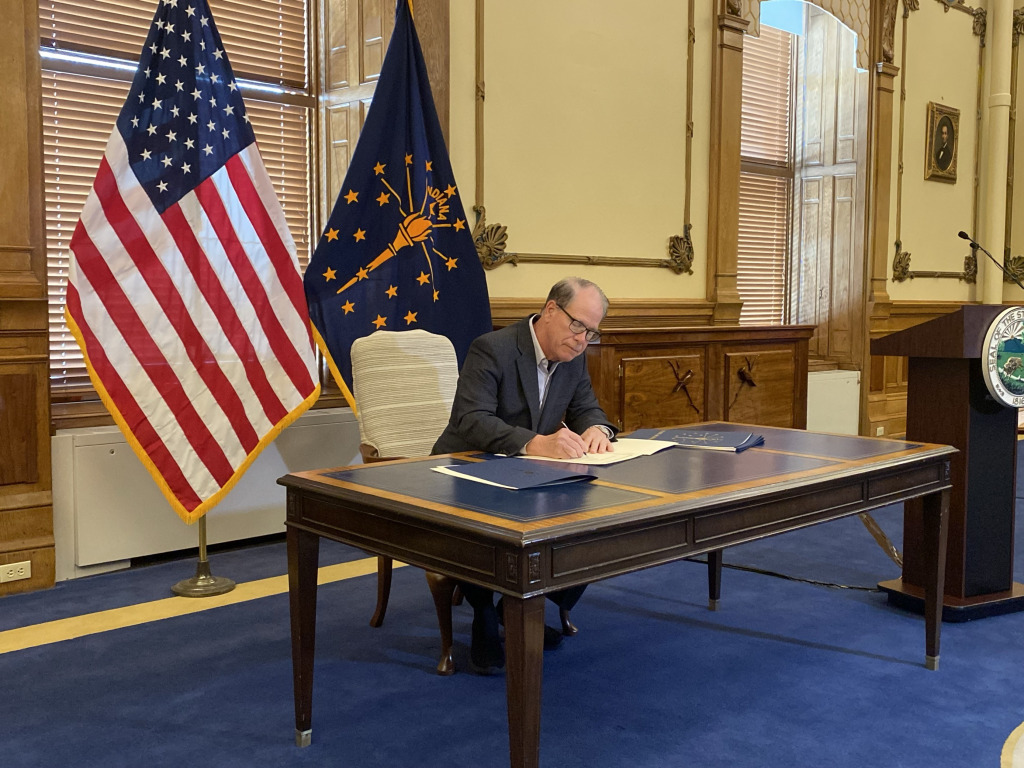
Gov. Mike Braun signed nine executive orders Wednesday afternoon that he said will provide clarity on health care pricing and will work toward his campaign promise of reducing Hoosiers’ medical bills.
The orders largely direct state agencies to audit current programs and coverage as a means to find savings. He also will require information to be made publicly accessible for the “atrophied consumer.”
“There’s so much room for improvement,” Braun said during a Wednesday news conference. “We are going to be constantly out there encouraging our own providers to get with us, to start embracing competition and transparency to make healthcare more affordable and especially transparent.”
Braun said Wednesday his administration would “use the carrot as opposed to the stick,” meaning they will incentivize rather than penalize, to achieve lower prices.
Dr. Gloria Sachdev, Braun’s secretary of health and family services, has long advocated for policy measures to lower health care costs. She most recently served as president and CEO of the Employers’ Forum of Indiana, an employer-led nonprofit that seeks to improve the value of health care services. Under her leadership, the Employers’ Forum of Indiana released a hospital price and quality dashboard and conducted several price transparency studies.
Health care transparency has been a focus of some state legislators this year. Wednesday’s executive orders broadly mirror some of the details in House Bill 1003, authored by Public Health Committee Chair Rep. Brad Barrett, R-Richmond. HB 1003 seeks to install measures to increase price transparency and the amount of information Hoosiers have about their treatment.
One of Wednesday’s orders, EO 25-22, requires an evaluation of nonprofit hospitals’ charity care, specifically the value of this care compared to the hospitals’ tax savings. The goal, according to a news release from Braun’s office, is to make sure those hospitals “fulfill their commitment to public service.”
Last week, House Republicans filed a bill threatening to strip these hospitals of their state tax status if they were found to be overcharging patients. House Bill 1004 would require nonprofit hospitals to submit annual reports to the state comparing their billed services to the Medicare reimbursement rate for those same services. Under the bill, if the charges exceed 200% of that reimbursement rate, the hospital could be forced to forfeit its Indiana nonprofit status.
The other executive orders signed Wednesday were:
- EO 25-20 directs the Department of Health to continue to report terminated pregnancies as required by law.
- EO 25-21 directs state agencies to improve price transparency for their health care services.
- EO 25-23 tells state agencies to work on affordability measures related to surprise billing, pharmacy benefit managers and drug prices.
- EO 25-24 requires audits of Medicaid and State Employee Health Plan expenditures conducted by the Family and Social Services Administration and the State Personnel Department.
- EO 25-25 directs the FSSA to create a dashboard to streamline programs and improve quality and cost of care.
- EO 25-26 asks state agencies to share data to improve efficiency.
- EO 25-27 directs state agencies to investigate the usage of the 340B Drug Pricing Program, a drug discount program.
- EO 25-28 directs the Department of Insurance to allow health insurers to offer insurance split-risk pools, a method of grouping individuals in order to lower health care costs.
On Jan. 15, Braun signed nine other orders issuing a variety of directives, including requiring state employees to return to full-time in-person work and stripping diversity, equity and inclusion policies from state government.
A full list of executive orders is available online.
Please enable JavaScript to view this content.
Gov. Braun’s recent executive orders represent a meaningful step toward improving health care affordability and transparency in Indiana. However, more needs to be done to address the systemic issues driving up costs. Several alternative approaches could further enhance these efforts:
Disincentivizing Emergency Department (ED) Overuse:
One way to manage costs is by addressing the common use of emergency departments as primary care facilities, particularly among Medicare and Medicaid beneficiaries. Introducing nominal co-pays for non-emergency visits could encourage individuals to seek care in more cost-effective settings, such as urgent care centers or primary care offices. This approach has been successfully piloted in other states, resulting in reduced ED volumes and significant cost savings.
Analyzing Hospital Expenses Beyond Labor:
Labor is undoubtedly a substantial portion of hospital expenses, but it’s not the sole driver. Key areas such as supply chain costs, pharmaceuticals, and medical technology should be audited to identify potential savings. Statewide initiatives, like the creation of a purchasing pool, could leverage collective bargaining to negotiate lower prices on high-cost items such as implants, imaging equipment, and medications.
Expanding Preventive Care Programs:
Investment in preventive care can reduce long-term costs by identifying and managing chronic conditions early. Expanding community health programs and incentivizing primary care visits through lower co-pays can reduce hospitalizations and improve outcomes. Additionally, Indiana could partner with employers to promote wellness programs that have shown to lower healthcare expenditures over time.
Enhancing Utilization of the 340B Program:
EO 25-27 mentions investigating the use of the 340B Drug Pricing Program. The state could encourage nonprofit hospitals and eligible providers to expand access to this program, ensuring patients benefit directly through discounted drug pricing at the point of care.
Public Reporting of Hospital Financial Metrics:
Transparency is key to understanding the cost drivers in health care. Public reporting of financial metrics, such as cost-to-charge ratios and charity care provided, can ensure hospitals fulfill their community benefit obligations. However, the proposed cap on charges at 200% of Medicare reimbursement may not adequately reflect the actual cost of providing care, as Medicare rates often fail to cover expenses. Instead of a rigid cap, Indiana could explore tiered benchmarks tied to the complexity and cost of services, coupled with incentives for hospitals that achieve high-quality outcomes while maintaining fair pricing structures.
Promoting Value-Based Care Models:
Indiana could incentivize providers to adopt value-based care models, which emphasize outcomes over service volume. By linking provider compensation to the quality of care and patient outcomes, the system could move toward a more sustainable and cost-effective structure.
While Gov. Braun’s orders demonstrate a commitment to making healthcare more affordable, innovative strategies such as these can complement his initiatives, ensuring Indiana becomes a leader in both health care quality and cost management.
ChatGPT
In a state other than Indiana, many, most, or all of this would be possible. But this, this is Indiana. The hospital/pharmaceutical lobby is strong. And the legislature is either, or both, clueless or bought and paid for…
Other than Illinois, most neighboring states are in some sort of pooling arrangement as discussed in the second paragraph. Indiana, an independent, strongly individualist state, went it alone…cause, we know better.
The problem with most of the suggestions for more primary care early prevention programs, especially for lower income medicaid and medicare recipients, is the primary care physicians won’t participate because reimbursement levels are too low. Indiana decided to cut compensation levels for the providers, and in return had higher Emergency Department and pharma costs. We got the incentives backwards, but we sure stuck it to those overpaid doctors…
Value based services is the model used by CMS to evaluate, and penalize by additional withholding of compensation for hospitals and service providers. Again, great idea. Except it led to not providing services at all to the high risk. The high risk were sent from suburban hospitals to downtown hospitals, or the Community system, which were penalized. we put all the bad eggs in one basket, and shipped them away from the suburban hospitals.
How about we bring the doctors and nurses and other interested parties (like, maybe, patients and consumers) to the big table and see if we can find a better solution. Because the process we’re using isn’t working…Indiana has among the highest health care costs in the nation…
But for now, it continues to be a model based on the beating of care providers will continue until their morale improves, they take on money losing patients, and they provide more cost reductions.