
Subscriber Benefit
As a subscriber you can listen to articles at work, in the car, or while you work out. Subscribe NowThe Rev. Josh Peyton didn’t become a musician to post content as a social media influencer.
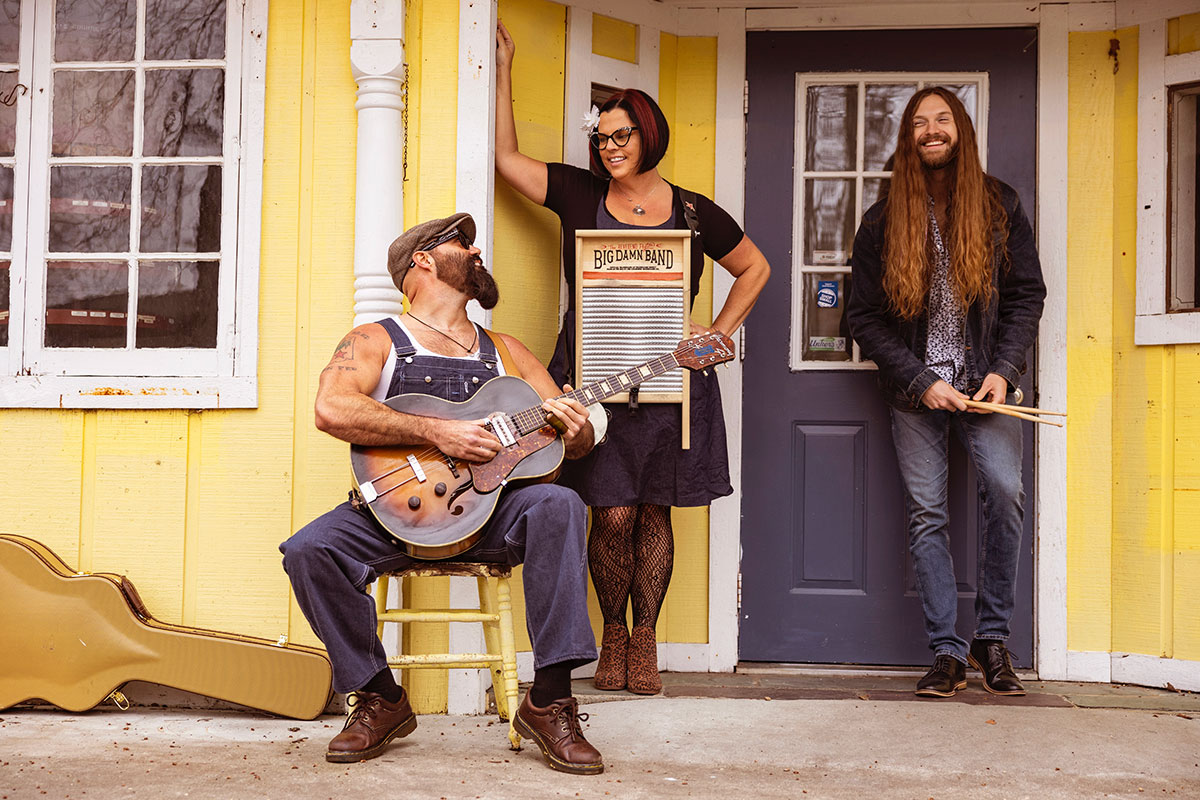
He’s a 43-year-old guitarist who specializes in rural blues, a style associated with Mississippi icons from a century ago. As leader of the Rev. Peyton’s Big Damn Band—a trio based in Brown County—Peyton has taken his music to audiences in 38 countries and 48 states.
And part of his job is self-promotion on platforms such as TikTok and Instagram, regardless of whether he enjoys it. Fortunately, he’s married to “Washboard” Breezy Peyton, a bandmate who’s diligent about the need to spread the word.
“One day there was a pretty sunset,” Josh Peyton said, recalling a time between tours back home in Indiana. “Breezy said, ‘Hey, go play something on guitar.’ I said, ‘What am I going to play?’ She said, ‘I don’t know. Just grab the guitar and play something before this pretty sunset’s gone.’”
Peyton stepped outside, collected inspiration from the sunset and improvised a melody for a video clip destined to be consumed amid an onslaught of political commentary, amateur medical advice and comedians doing crowd work.
The melody also became the basis for the title track of new Big Damn Band album “Honeysuckle.” Thanks, social media.
“Honeysuckle,” the Big Damn Band’s 11th studio album, arrives on Friday. Josh, Breezy and drummer Jacob Powell will celebrate the release by playing a free in-store show at 6 p.m. Friday at Indy CD & Vinyl, 806 Broad Ripple Ave.
The song “Honeysuckle” is a smooth ballad that pays tribute to Breezy. “Hard to handle, soft to touch, she’s a lot but not too much,” Josh Peyton sings. “She can wiggle, she can hunch. I know a little, she knows a bunch. Honeysuckle on my vine, trouble, trouble, but it’s all mine.”
The tender tune sets the tone for an album that’s entirely unplugged. Although Peyton has integrated electric guitars into recent recordings, his tools on the “Honeysuckle” album are restricted to his voice, his hands applied to acoustic guitars and what’s captured by microphones.
It’s a method beamed from yesteryear, but Peyton also knows what it’s like to be a viral sensation on YouTube. In 2016, he racked up millions of views after demonstrating his one-of-a-kind “guitgun”—a combination instrument and shotgun that Peyton played and fired in an outdoor video.
Of course, viral hits aren’t predictable. A more reliable way to increase online exposure is to pay for it, Peyton said.
“We pay a fortune in Facebook ads just so people see our stuff,” he said. “People don’t realize that if you don’t pay a little bit, or a lot, really, you might as well not even show up that day. If you have the budget to throw tons of money in it, well, you do the math on that. You’re going to be seen by more people, and it becomes exponential. It’s a really great path for the already big to get bigger. It’s not a great way forward, otherwise.”
In contrast to major label artists, the Big Damn Band is an independent act that issues recordings on its own label, Family Owned Records.
Special guests
Peyton initially planned “Honeysuckle” as a solo album, but he believed the songs could be enhanced by more musicians.
“I thought, ‘I’d love to have some background vocals here and some washboard here and some tambourine here,’” Peyton said.
Breezy Peyton and Powell stepped in to make “Honeysuckle” a group effort.
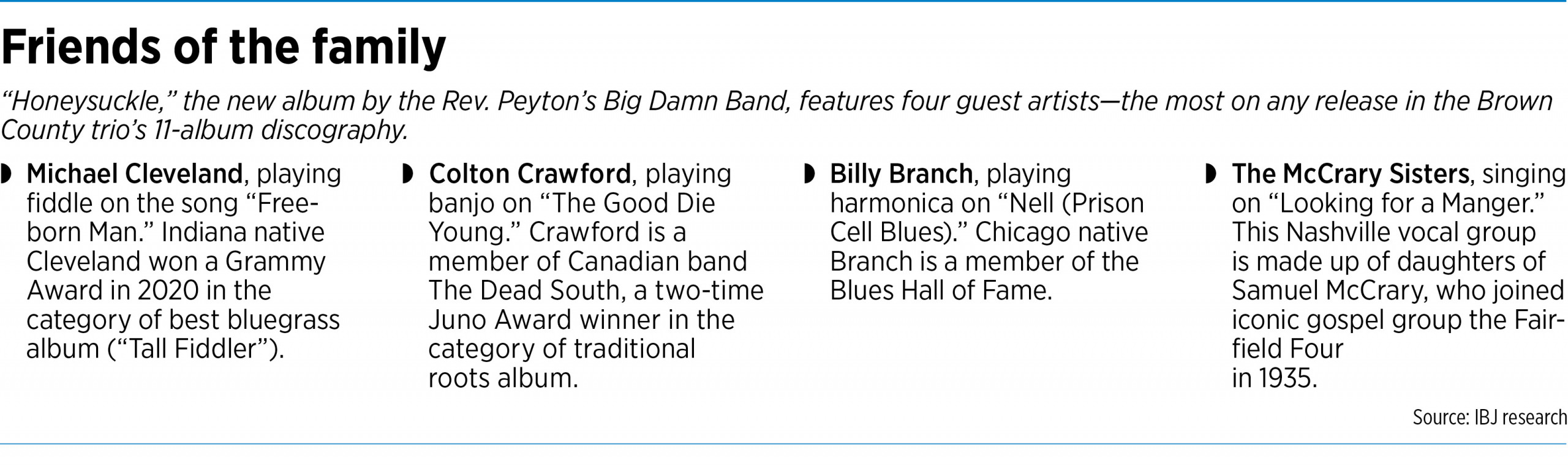
Then the album became home to four guest artists, the most in the Big Damn Band’s discography that dates to 2004 and debut release “The Pork n’ Beans Collection.”

“Everybody I asked said, ‘Yes,’” Peyton said. “It was just a really cool thing.”
Peyton enlisted fiddle player Michael Cleveland, banjo player Colton Crawford, harmonica player Billy Branch and gospel vocal trio The McCrary Sisters to appear on individual songs.
Crawford, a member of Canadian bluegrass band The Dead South, plays banjo licks to interact with Peyton’s guitar work on a song titled “The Good Die Young.”
Before focusing on banjo, Crawford was a metal-guitar player during his teenage years.
“I was drawn to banjo for the same reason I was drawn to metal guitar,” Crawford told IBJ. “It’s fast, technical playing. A lot of what banjo players do is write songs with these breaks and licks. It’s, ‘Hey, check out this crazy thing I came up with.’ It’s fun, but there’s a technical element to the writing and playing that I gravitate toward.”
When asked about the instrumental skills of Peyton, who graced the cover of Vintage Guitar magazine in January 2020, Crawford said he’s not qualified to talk on the topic.
“Anything I say about Rev’s guitar playing is going to be like a sixth-grader trying to explain Einstein’s theories,” Crawford said. “I love his style. It’s super technical. … Guitar is just like an extra limb for him. He has total mastery and total control of it.”
Mutual understanding
Lyrically, the “Honeysuckle” album offers a theme of empathy, Peyton said.
The song “Looking for a Manger” includes the passage, “Strangers you meet could be angels in need.”
Peyton wrote about the origin of “Looking for a Manger” in a Facebook post that complimented The McCrary Sisters’ contributions to the song.
“They truly elevate it beyond what I had dreamed possible,” Peyton wrote about the sibling trio. “When I was a kid, my mom told me that sometimes strangers you encounter were angels in disguise. Inspired by that memory, and gospel songs like Blind Willie Johnson’s ‘Everybody Ought to Treat a Stranger Right,’ I built the song up from a riff I had been working on.”
Peyton is the author of multiple songs expressing solidarity with people facing financial hardship, from 2008’s “Can’t Pay the Bill” to 2018’s “Poor Until Payday.”

“I think what makes a good musician and a good songwriter is someone who truly cares about people and understands the condition,” said Matthew Fecher, a music entrepreneur who hired the Big Damn Band to play Colorado’s South Park Music Festival two decades ago. “I believe the Rev truly cares about his fans, and he doesn’t do it because, ‘That’s the thing you have to do. Let’s check off a box.’ His connections are genuine.”
Before launching a music festival in Colorado, Purdue University alum Fecher helped unify the Indianapolis music community when he founded the Indianapolismusic.net website.
Fecher, a software developer, eventually moved to Atlanta, where he co-founded AudioKit Pro, a company that makes apps used on Apple’s mobile operating system. He returned to Indianapolis during the pandemic and presently teaches at Indiana University Indianapolis and the Herron School of Art & Design.
Last fall, Peyton appeared as a guest speaker in a “Music Tech Mondays” series organized by Fecher at IU Indianapolis.
“He has that old-school musicianship when he makes a record, but he also understands all the modern technology about it,” Fecher said of Peyton. “If you ask him about preamps, he’ll talk for half an hour. He really understands the record-making process, which is a big part of what we do at IU Indianapolis—the musicianship and the technology, and he embodies both.”
Back to the future
Peyton served as producer for the “Honeysuckle” album, and the recording was mixed by Vance Powell—winner of Grammy Awards for filling the same role on three Chris Stapleton albums.
On the topic of technology, Peyton said his phone has influenced his creative process.
“For years, I made no demos,” he said, referring to rough-draft recordings that precede formal efforts. “My entire career had just been in my head. But lately I’ve been making more demos, and a lot of them are just on the voice recorder on my phone.”
The phone recordings are highly compressed, Peyton said, and reminiscent of 78 RPM recordings. The 78 RPM format was popular during the first half of the 20th century, when early blues musicians blazed the trail adopted by the Big Damn Band.
Alongside Peyton’s original compositions on “Honeysuckle,” the album features covers of Robert Johnson’s “If I Had Possession Over Judgement Day” (recorded in 1936), the traditional “Keep Your Lamp Trimmed and Burning” (recorded by Blind Willie Johnson in 1928) and Blind Lemon Jefferson songs “One Dime Blues” (1926) and “Nell (Prison Cell Blues)” (1928).
“The style of music I play, I never set out to chase an algorithm,” said Peyton, who grew up in Westfield. “No one was supposed to like this, anyway. The fact that we have had a fan base and a career doing this is a miracle. I think it probably would be easier to go back in time and start doing hip-hop or something to become an international star than it would to take country blues and create any kind of a career out of it.”
Nevertheless, the Big Damn Band rolls on. The trio will spend March on the road as part of a U.S. tour supporting Gaelic Storm, a band known for its below-decks appearance in the 1997 film “Titanic.” In June and July, the Big Damn Band is scheduled to play 24 shows in Europe.•
Please enable JavaScript to view this content.
I fondly remember y’all at Shiner Bocktoberfest many moons ago!