
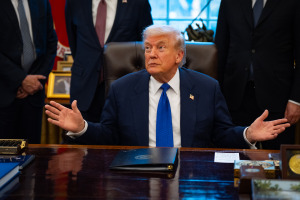
Trump sees a hot economy as midterm elections approach
President Donald Trump said at a recent Cabinet meeting that the economy could hit growth “numbers that have never been hit before.”
The recent pickup in inflation has led some economists to postpone their projections for when the Federal Reserve will begin cutting interest rates.
Read More
The latest figures point to a strong but slowing economy that has been tempered by the Federal Reserve’s aggressive efforts to control inflation.
Read More
Builders in the nine-county Indianapolis area filed only 457 single-family building permits in October, down a whopping 46% from 845 in the same month of 2021.
Read More President Donald Trump said at a recent Cabinet meeting that the economy could hit growth “numbers that have never been hit before.”
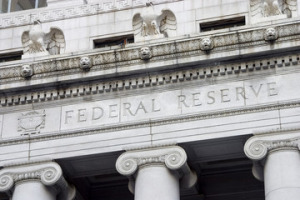
President Trump told reporters Friday that he didn’t want to ask Kevin Warsh to agree to cut rates because that would be “inappropriate,” even if “it probably would be allowed.”
The central bank said there are signs the job market has stabilized while it also said growth was “solid,” an upgrade from last month’s characterization as “modest.”

So far, the White House has not provided any detail about what will happen to credit card companies that don’t lower card rates.
The minutes showed that even some Fed officials who supported the rate cut did so with reservations, with some saying they wanted to wait for more data before making any further moves.
Wednesday’s cut reduced the Fed’s key interest rate by a quarter-point, to about 3.6%, the lowest it has been in nearly three years.
The Federal Reserve faces an unusually contentious meeting this week that will test Chair Jerome Powell’s ability to corral the necessary support for a third straight interest rate cut.

Core inflation was muted in September and will bolster the case for a cut to the Federal Reserve’s key interest rate at its next meeting.

The differences have been exacerbated by the government shutdown’s interruption of economic data, a particular challenge for a Fed that Chair Jerome Powell has often described as “data dependent.”
Chair Jerome Powell said in a news conference that another rate cut in December was “not a foregone conclusion.”
The minutes provide insight into how the Fed’s policymakers were thinking last month about inflation, interest rates, and hiring.
Jerome Powell’s approach is in sharp contrast to some members of the Fed’s rate-setting committee who are pushing for faster cuts.
The move is the Fed’s first cut since December and lowered its short-term rate to about 4.1%, down from 4.3%. The central bank’s focus has shifted quickly from inflation to jobs, as hiring has ground nearly to a halt in recent months
At this week’s Federal Reserve meeting, the decision it will make on interest rates—usually the main event—is just one of the key unknowns to be resolved when officials gather Tuesday and Wednesday.

Borrowing costs on 15-year fixed-rate mortgages, popular with homeowners refinancing their home loans, also fell.

The drop in producer prices makes it even more likely that the Federal Reserve will cut its benchmark interest rate next week for the first time this year.
Federal Reserve Chair Jerome Powell opened the door ever so slightly to lowering a key interest rate in the coming months but suggested the central bank will proceed cautiously as it continues to evaluate the impact of tariffs and other policies on the economy.

Borrowing costs on 15-year fixed-rate mortgages, popular with homeowners refinancing their home loans, also fell.
Cash-out refinances, in which homeowners take out a loan for more than they owe on their mortgage and pockets the difference, accounted for roughly 60% of all home loan refis in the second quarter.

The jobs report that arrived last week, only a couple of days after the Fed voted on interest rates, showed that employers hired far fewer workers last month than economists expected.