

White House poised to announce winners of competition to produce hydrogen fuel
Earlier this year, an Indiana group seeking to land one of the hydrogen hubs joined forces with a coalition representing Michigan and Illinois to enhance the chance.
Earlier this year, an Indiana group seeking to land one of the hydrogen hubs joined forces with a coalition representing Michigan and Illinois to enhance the chance.

Majority Leader Steve Scalise was nominated for speaker by a majority of Republicans early Wednesday. But a significant number of Republicans said they planned to protest his official election.

The 216-210 historical vote, forced by a contingent of hard-right conservatives, throws the House and its Republican leadership into chaos.

Even some conservative justices sounded skeptical of arguments that the agency, created after the 2008 financial crisis to regulate mortgages, car loans and other consumer finance, violates the Constitution in the way it is funded.

Her departure would reduce the Republican majority in the U.S. House of Representatives and create the possibility that Indiana Gov. Eric Holcomb would have to call a special election before May.
A last-ditch effort on Capitol Hill on Saturday staved off a government shutdown with just hours to spare, as House Speaker Kevin McCarthy (R-Calif.), in an abrupt strategic reversal, offered a plan that won the support of nearly all Democrats and most Republicans.
The bill’s complete failure a day before Saturday’s deadline to fund the government leaves few options left to prevent a shutdown.

A centrist Democrat who was elected to the Senate in 1992 in the “Year of the Woman,” Feinstein broke gender barriers throughout her long career in local and national politics.
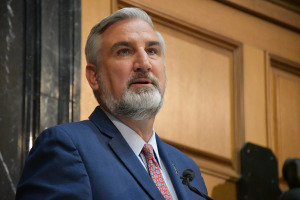
Indiana Gov. Eric Holcomb told the press Wednesday that the state was prepared for what appears to be an imminent federal government shutdown that would affect nearly 24,000 Hoosiers.
On Capitol Hill, the two chambers are working on diverging tracks to extend government funding, which is set to expire at 12:01 a.m. Sunday.
If adopted, it would fund the government for six weeks with additional money for Ukraine and domestic disaster relief. Without additional funding, the government will shut down Sunday.

The long-awaited move seeks to bar the company from allegedly abusing its powers to raise prices for shoppers and levy high fees against businesses that sell on its platform.

Railroad safety has become a key concern nationwide ever since a train carrying hazardous chemicals derailed and caught fire in East Palestine, Ohio, in February.

About 75 school districts statewide still had 50% or more of their allocations available at the end of August.

Starting Sept. 25, people can request four free tests per household through covidtests.gov. Officials say the tests are able to detect the latest variants and are intended to be used through the end of the year.

Indiana is one of eight states selected for a regional technology and innovation hub that will be part of a federally funded national network of centers supporting domestic production of microelectronics, semiconductor manufacturing and other advanced technologies.

The White House said the program will employ more than 20,000 young adults who will build trails, plant trees, help install solar panels and do other work to boost conservation and help prevent catastrophic wildfires.

The local low-income housing authority has faced recent financial troubles, understaffing, and litigation from the Indiana attorney general and tenants. In late October 2022, the agency was hit by a ransomware attack.
The IRS has received 3.6 million claims for the credit over the course of the program. It said hundreds of criminal cases have been started and thousands of claims have been referred for audit.

The Indiana senator pointed to a “rising trend” in mandates being brought back at certain schools around the country.