

Indiana, other states eye allowing concealed carry of guns without permit
Fifteen states already allow concealed carry without a permit, and lawmakers in nine others have proposed allowing or expanding the practice.
Fifteen states already allow concealed carry without a permit, and lawmakers in nine others have proposed allowing or expanding the practice.
Indiana politicians are seizing on the upheaval caused by the pandemic to push forward a vast expansion of taxpayer funding for private education.
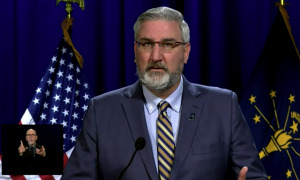
Normally, the governor gives the annual State of the State address before a joint session of the Indiana General Assembly inside the Indiana House chamber. But for safety reasons, Holcomb pre-recorded the speech without an audience.
A Democratic-backed proposal that would unlink Indiana from the current federal minimum wage that’s remained at $7.25 an hour since 2009 is unlikely to get traction in the General Assembly.

With the FBI warning of potential for violence at all state capitols, the ornate halls of government this weekend looked more like heavily guarded U.S. embassies in war-torn countries. In Indiana, however, there was little sign that officials were concerned about a protest scheduled for Sunday.

The FBI has warned that potentially violent protests could take place at all state capitols over the next several days leading up to the inauguration of President-elect Joe Biden.
Bill sponsor Sen. Jack Sandlin of Indianapolis referred to the legislation as a “preemptive measure.”
The two grant programs were initially announced last week as part of the House GOP legislative agenda, but the exact funding amounts were not shared at that time.
House Bill 207, authored by Republican Sen. Blake Doriot of Goshen, would change how cities and counties with wheel and vehicle excise taxes in place are required to spend Motor Vehicle Highway funds for the next two years.
The bill would shield businesses and individuals from coronavirus civil liability lawsuits unless there was gross negligence or willful or wanton misconduct that could be proven with “clear and convincing evidence.”
On Wednesday during his weekly press briefing, Gov. Eric Holcomb said he is deploying 625 troops to Washington, D.C., from Saturday through Jan. 22.

The measure, Senate Bill 74, would allow workers to decline any immunizations for medical, religious or personal reasons. The Pensions and Labor Committee heard testimony Wednesday but delayed a vote.
The $35.2 billion budget, which Office of Management Director Cris Johnston and Budget Director Zac Jackson presented to the State Budget Committee on Wednesday morning, also restores the state’s reserve balance to $2.3 billion each year.

Indy Eleven officials said last week that they plan to announce a location for the proposed $550 million Eleven Park development—which would include a stadium—by the end of March.
The bill, authored by Republican Rep. Greg Steuerwald, would largely ban the use of chokeholds, penalize officers for intentionally turning off body and vehicle cameras, and make it easier for the Indiana Law Enforcement Training Board to decertify bad acting officers.
Todd Rokita campaigned on a platform of providing certainty in uncertain times, vowing to support constitutional liberties that he said are often under attack. He repeated those promises in his Monday remarks.
The state’s lead economic development agency announced Thursday that it secured 282 business relocation or expansion deals in 2020 that are expected to result as many as 31,300 new jobs.
The list of top priorities for Indiana House Republicans this year includes establishing or beefing up several one-time grant programs aimed at improving public health, expanding rural broadband and supporting small businesses and the hospitality industry.

Senate Bill 168, authored by Republican Sen. Jack Sandlin, would create a five-member board that would oversee and govern the police department.
Senate Enrolled Act 148 would have prevented all local governments from regulating any aspect of landlord-tenant relationships and would have blocked tenant protections that the city of Indianapolis had put in place last spring.